
Complete Buyer’s Guide to Professional PPF Manufacturer: Evaluating KSB at Automechanika Dubai


(YorkPedia Editorial):- Dongguan, Guangdong Jun 24, 2026 (Issuewire.com) – As the automotive aftermarket expands across the Middle East, Africa, and Southern Asia, regional trade exhibitions have become crucial hubs for sourcing premium materials. Among these, Automechanika Dubai stands out as the premier trade exhibition for the automotive aftermarket in the wider Middle East. For international distributors, wholesalers, and sourcing managers, navigating the massive exhibition halls can be overwhelming. With hundreds of booths showcasing automotive films, making an informed procurement decision requires a strategic approach. Finding a truly Professional PPF Manufacturer amid a sea of trading companies and downstream suppliers is often the primary challenge for attendees.
Distributors visit trade shows to solve fundamental operational problems, including supply chain instability, inconsistent product quality, rising costs, and a lack of tailored OEM capabilities. This guide provides a structured framework for evaluating paint protection film (PPF) suppliers at major exhibitions like Automechanika Dubai, using the manufacturing standards and product lines of experienced industry players to illustrate what a tier-one partnership looks like.
STEP I: Verifying True Manufacturing Credentials and Factory Scale
The initial phase of evaluating any potential partner at an international trade exhibition involves distinguishing between factory-direct manufacturers and independent trading companies. While trading companies can offer diverse product portfolios, they often lack control over manufacturing consistency, long-term pricing stability, and customized product development.
When engaging with exhibitors, professional buyers must look beyond the booth design and evaluate core operational metrics. A true industry leader usually operates a large-scale, climate-controlled manufacturing facility. For instance, KSB, a professional window film and PPF manufacturer with over 20 years of experience, operates a state-of-the-art 50,000-square-meter production facility equipped with three highly automated extrusion and coating lines.
An annual production capacity of up to 80 million square meters allows a manufacturer to ensure stable global logistics, which helps protect distributors from sudden supply shortages. Buyers should ask detailed questions regarding cleanroom standards, raw material sourcing, and annual output capacities to ensure the vendor can support large-scale B2B demands.
STEP II: Assessing International Certifications and Compliance Standards
A manufacturing facility’s scale must be backed by a robust quality management system. In the automotive protective film sector, adherence to international standards is a non-negotiable metric for assessing product reliability. At trade exhibitions, distributors should request official documentation regarding factory audits and material compliance.
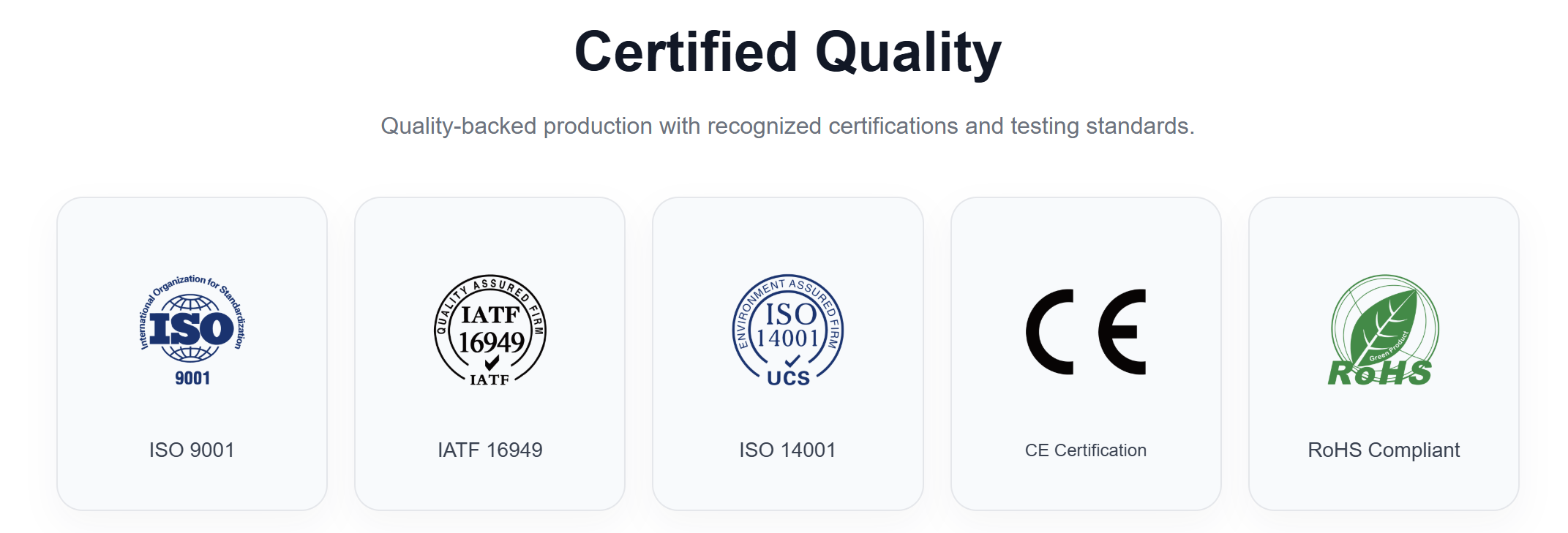
A premier manufacturing partner maintains a comprehensive suite of international certifications, including:
- ISO 9001 & ISO 14001:Demonstrating structured quality management and environmental responsibility across all manufacturing phases.
- IATF 16949:The restrictive automotive quality management standard that validates a manufacturer’s capacity to supply parts to automotive original equipment manufacturer (OEM) supply chains.
- CE & RoHS Compliance: Ensuring the products meet safety, health, and environmental protection requirements for global distribution, including regulated European markets.
Reviewing these credentials at the booth helps verify that the products will comply with local import laws and perform reliably under real-world conditions.
STEP III: Analyzing Material Science and Technical Innovations
The core value of paint protection film lies in its material composition and coating technology. The Middle East and adjacent regions present severe challenges for automotive films, including intense UV radiation, extreme summer temperatures, airborne sand, and high salinity. Standard aliphatic polyurethane or low-grade hybrid films degrade quickly under these conditions.
During the exhibition, buyers should analyze the structural design of the film. High-performance PPF requires premium Thermoplastic Polyurethane (TPU) base materials paired with advanced surface topcoats. The structural integrity of a supplier’s product line can be evaluated through several key technical indicators:
- Self-Healing Technology: Advanced topcoats feature heat-activated self-healing properties, allowing minor swirl marks and surface abrasions to disappear under natural sunlight or mild heat.
- Optical Clarity and Gloss Enhancement: Premium TPU films offer high optical transparency and gloss, which enhances the original depth of vehicle paint without introducing orange-peel texture.
- Anti-Staining and Hydrophobic Performance: The top coating must repel environmental contaminants, oil, water spots, and road grime, reducing the risk of long-term yellowing or surface dulling.
- Climate Resistance: The adhesive layer must be engineered to withstand severe temperature variations without lifting, edge-bubbling, or leaving residue upon removal.
Evaluating these material characteristics helps ensure that the film can withstand challenging local climates over a multi-year service life.
STEP IV: Evaluating Portfolio Breadth and Tiered Market Solutions
A professional manufacturer should provide a comprehensive, multi-tiered product line that allows distributors to target different market segments and price points. Relying on a single type of film limits a distributor’s ability to serve both premium detailing studios and high-volume commercial fleets.
An optimized product portfolio typically includes distinct series tailored to specific market demands:
- Premium Tier (Top Series): Constructed from top-grade USA-sourced TPU, maximizing stain resistance, high-gloss gloss enhancement, and long-term durability for luxury and exotic vehicles.
- Intermediate Tier (D Series): Developed with reliable German TPU, offering a balanced combination of flexibility, weather resistance, and cost-effectiveness for mainstream automotive markets.
- Value Tier (G Series): Designed for cost-sensitive markets, providing stable everyday protection and consistent installation performance for high-volume fleet applications.
- Specialized Series: Including functional variations such as matte finishes, specialized thicknesses ranging from 6.5mil up to 12mil, and advanced architectural or smart film integrations.
A broad product range allows regional distributors to source all their protective films from a single vendor, simplifying inventory management and lowering freight costs.
STEP V: Auditing OEM/ODM Capabilities and Private Label Support
For large-scale distributors and established regional brands, the ability to customize products and packaging is essential for building local brand equity. A factory’s flexibility in handling private label requests is an important indicator of its service quality.
When discussing partnerships at trade shows, buyers should evaluate the manufacturer’s end-to-end OEM/ODM framework, which should cover:
- Custom Product Development: The ability to adjust film thicknesses, adhesive tack levels, and topcoat properties to meet regional climate demands.
- Brand Packaging Customization: Full support for custom-printed boxes, branded core tubes, specialized release liners, and custom roll labels.
- Comprehensive Sample Validation: A structured process for producing, testing, and approving custom samples before initiating full production runs.
Partnering with an experienced OEM manufacturer allows regional distributors to shift from selling generic products to building a distinct brand identity backed by reliable factory support.
Summary Checklist for Trade Show Sourcing
To make the most of your time at major aftermarket exhibitions like Automechanika Dubai, buyers can use this objective checklist when visiting booths:
- Confirm the location, size, and ownership of the production facility.
- Review physical copies of ISO 9001, IATF 16949, CE, and RoHS certificates.
- Inspect physical product samples under high-intensity lighting to check for clarity, gloss, and defects.
- Test the film’s elasticity, edge-wrapping stability, and adhesive residue characteristics on demonstration panels.
- Confirm that the manufacturer offers a tiered product range (e.g., premium USA TPU, intermediate German TPU, and high-volume value options).
- Verify the specific terms of their OEM services, including Minimum Order Quantities (MOQs) and packaging options.
By using this structured framework, international buyers can look past basic sales pitches and select a reliable manufacturer capable of supporting long-term business growth.
For more information on professional manufacturing capabilities and premium automotive film solutions, visit the official corporate website at https://www.ksbwindowfilm.com/
Source :Dongguan Kashibang Film Materials Co., Ltd.
This article was originally published by IssueWire. Read the original article here.
